
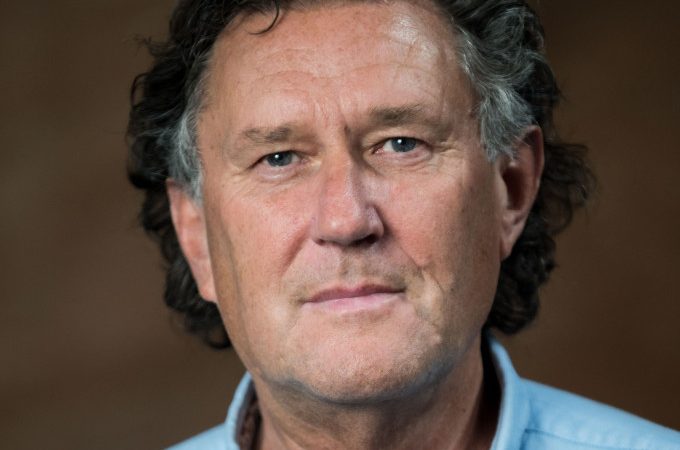
Ben Barnes on the genesis of Eoin Colfer’s My Real Life
Four Rivers returns to the stage this year with a nationwide tour of Eoin Colfer’s comedic and very moving play about love, life and death, My Real Life, starring Garrett Lombard and directed by Heather Hadrill.
The life of this play began when Ben Barnes approached Eoin Colfer to write a short play to help mark the fortieth anniversary of the founding of the Wexford Arts Centre. The result was My Real Life which made up a quartet of plays by Eoin and fellow Wexfordian writers Colm Tóibin, Billy Roche and John Banville.
They were produced during the Wexford Festival Opera 2014 under the collective title WexFour. They were subsequently published in Ireland by Carysfort Press.
My Real Life, in its short form, comprised a series of mostly hilarious anecdotes recorded on his phone by Noel for his friend Richard by way of providing him with the ‘bones of a scéal’’ (story) to put a eulogy together after Noel, who is suffering from multiple sclerosis, has ended his life.
With his gift of storytelling and larger-than-life personality we can scarcely credit that this twenty-minute play is going to end in Noel’s death, and sure enough his best-laid plans are thwarted when sleeping pills he ordered off the internet turn out to be something else and the button he pressed on his iPhone to record his final message activated the GPS and not the recording facility.
The play was wildly successful with audiences* during WexFour, and Don Wycherley (the actor who played Noel) and I, having been around new work all our working lives, immediately thought that this was something which might be expanded into a full-length play and approached Eoin who readily agreed. Eoin – who is, of course, best known as the author of the Artemis Fowl books – had dabbled before in the theatre and collaborated with the Wexford composer, Liam Bates on a number of well-regarded forays into music theatre.
Don and I recognised straight away not only that Eoin’s penchant for dramatic writing and dialogue was very finely attuned to the rhythm and cadence of the Wexford voice, but also that he had that gift for seamless dramatic propulsion which, without drawing attention to itself, carries an audience on the crest of the wave of his forward-moving story. In a phrase used by Noel, he thoroughly ‘engages the well-wishers’ (ie the audience).
However, in our first serious meeting about the process of developing the play at a restaurant off George’s Street in Dublin, we all agreed that a string of anecdotes loosely held together with an absurdist ending would not cut it and if we really wanted to ‘engage the well-wishers’ for up to two hours in the theatre then the play had to really deliver on its premise of being a final word from beyond the grave of Noel, ‘being of sound mind and unsound body’. And that, furthermore, there needed to be an emotional through-line which pulsed through the piece without taking anything from the Rabelaisian humour that carried the story along.
The ante was upped and Eoin rose magnificently to the challenge.
While retaining the structural device of a man speaking a message into an old-fashioned’
Noel now leaves more than a series of funny stories for his friend Richard to conjure with. He also leaves a confession of sorts when he tells of how he lost the love of his life, Rose, through the inability of his immature thirty-year-old self to fully appreciate what he had in her. It is only in retrospect that he realises ‘when the light from the streetlamp came in through the net curtain and landed on your cheek that it was not possible for a man to be any happier. I was at the pinnacle, and I was all unawares’. In an unbearably moving ending to the piece Noel testifies that he would gladly accept the ‘godforsaken fucking blight that’s lodged in my spine’ if he could reverse the moment he lost Rose.
That Eoin is able to bring us to this emotional pitch at the end of the play when we have laughed heartily with Noel throughout the night – even while the emotional depth charges were being stealthily deployed – is a testament to his great humanity, his comic genius and his skill as a writer and, yes, as a dramatist. When you meet Eoin with his twinkling eyes, his mischievousness, his white hair and trimmed beard, he seems only to be missing the conical hat that would suggest a benign wizard, but whatever about that he is certainly the wizard of the keyboard, the alchemist who turns words on the page into pure theatre.